 Trending in AU
It Starts In Your Feet. It Never Ends There.
What starts as foot pain works its way up to your knees and back over time. Here's how to stop it before it gets there.

Ask any worker who's been on hard floors for twenty years where their pain is, and almost none of them will say their feet. They'll tell you about their knees. Their lower back. The hip that seizes up on a cold morning. By the time it hurts enough to talk about, the feet have usually stopped being the loudest problem, which is exactly why almost nobody catches it in time.
Dr. Michael Torres has spent twenty years as a certified podiatrist watching that pattern repeat. Most of his patients are the same kind of people: tradesmen, warehouse crews, factory staff, miners, nurses, anyone who spends their whole shift standing and walking on concrete, steel, and tile. And the thing he wishes every one of them understood is that foot pain from hard floors is almost never just foot pain. It's the first domino. The one that knocks over everything else, quietly, over months, long before anyone connects it back to where it started.
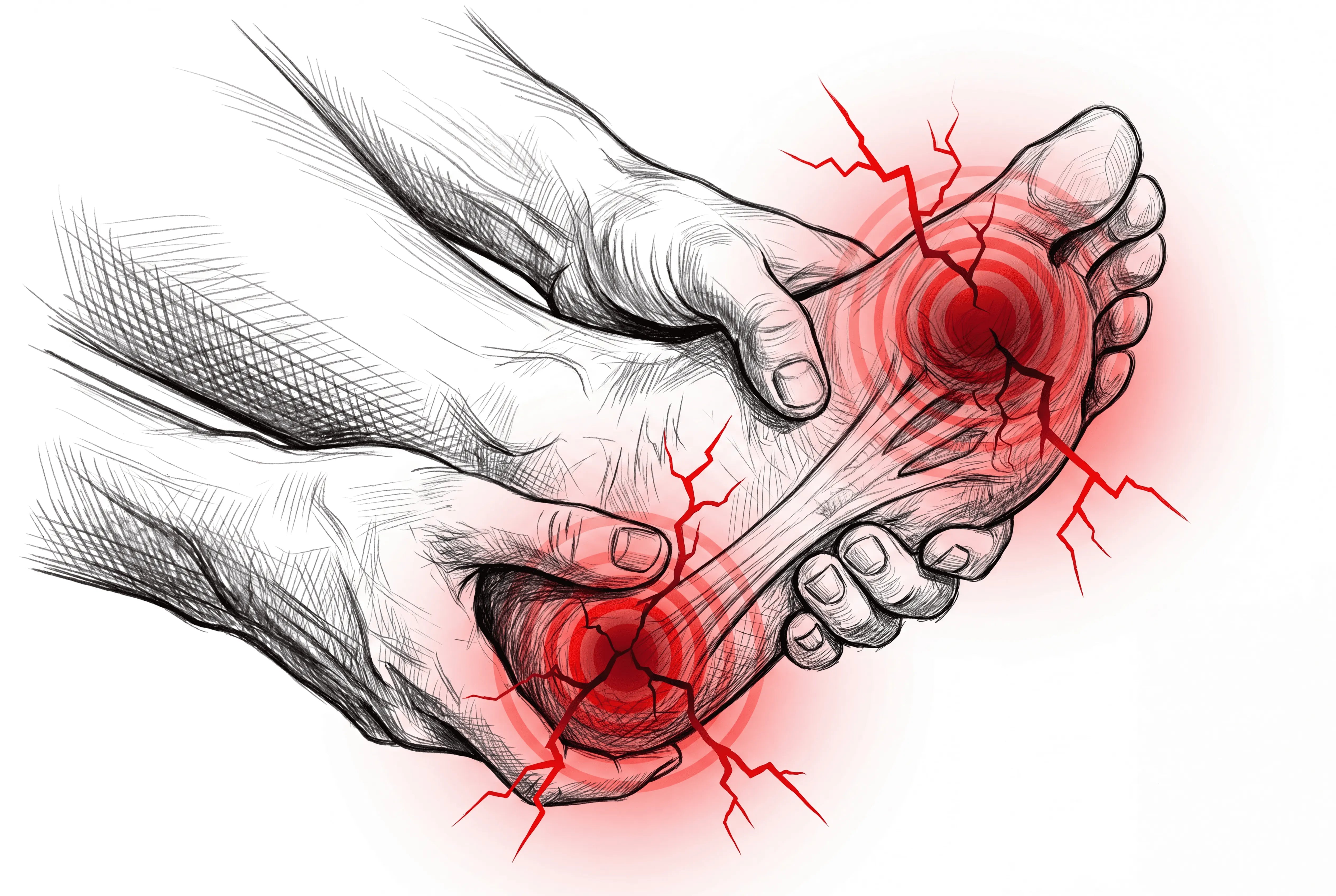
Why This Is Personal For Him
Torres didn't choose this field out of a textbook. He chose it because of his grandfather.
His grandfather laid concrete for thirty years. Hard, honest work, and he was good at it. But by the time he hit his sixties, something had changed. He could barely get down on the floor to play with his own grandkids anymore. He'd wave them off, say his back was giving him trouble, and stay in his chair.
“By the time he finally saw someone about it, it wasn't just his feet anymore. It was his knees, his hips, his whole back. Nobody caught it early enough to stop it.” — Dr. Michael Torres
Torres was one of those grandkids. He grew up watching a strong, capable man slowly get boxed in by his own body, giving up one thing at a time until there wasn't much left he could still do. Nobody around his grandfather knew what they were looking at. Nobody told him it was fixable. And that's the part that stuck.
“I've spent my whole career,” Torres says, “trying to be the person who catches it early. For someone else's grandfather.”
The Part Almost Nobody Sees Coming
Here's what Torres says makes this so dangerous: it doesn't feel like a warning. It feels like a bad week.
A rough shift. Feet that ache more than usual. Something you'll rest up and deal with eventually. So you push through it, because that's the job, and pushing through is what you've always done. It doesn't feel like the beginning of anything. It feels like the same sore feet everyone you work with has.
But it isn't costing you today. It's quietly deciding what your body will still let you do years from now. Whether you're the one down on the floor with your grandkids, or the one watching from the chair like his grandfather was. Whether you and your partner are still heading out for walks and hikes on the weekend, or whether that's already quietly fallen away and neither of you has said it out loud.
“And it's not just my grandfather. That's the pattern I've watched play out hundreds of times since. Sore feet, to knee pain, to back pain, to a patient sitting in my office genuinely asking me about surgery. On average, that whole progression takes eighteen to twenty-four months. And almost every single time, it was entirely preventable.”
Eighteen months. That's the window. And most workers spend it thinking they just need better shoes, buying another pair, feeling better for a fortnight, then landing right back where they started and blaming their own body for it.
How A Foot Problem Becomes A Back Problem
To understand why it spreads, Torres says, you have to understand what's actually failing, and it isn't your body.
Under your heel and the ball of your foot sits a natural cushion called the fat pad. It's built to last you a lifetime, absorbing the shock of every step so the bones and joints above it don't have to. It's the reason walking doesn't slowly wreck you.
The problem is what's between that fat pad and the floor. The insole. And standard insoles, even the ones inside expensive work boots, were never built to survive a real shift on a hard surface. Under that kind of sustained load, the foam compresses and doesn't spring back the way a proper cushion should. Within a few weeks, it's flat. Dead. Offering next to nothing.
Once that happens, there's nothing left between your heel bone and the concrete except that fat pad, now taking the full force of every step completely alone. It was never meant to do that. So it starts to thin out, and here's the cruel part: unlike a bruise or a pulled muscle, it doesn't grow back. That's called Fat Pad Atrophy, and it's permanent.
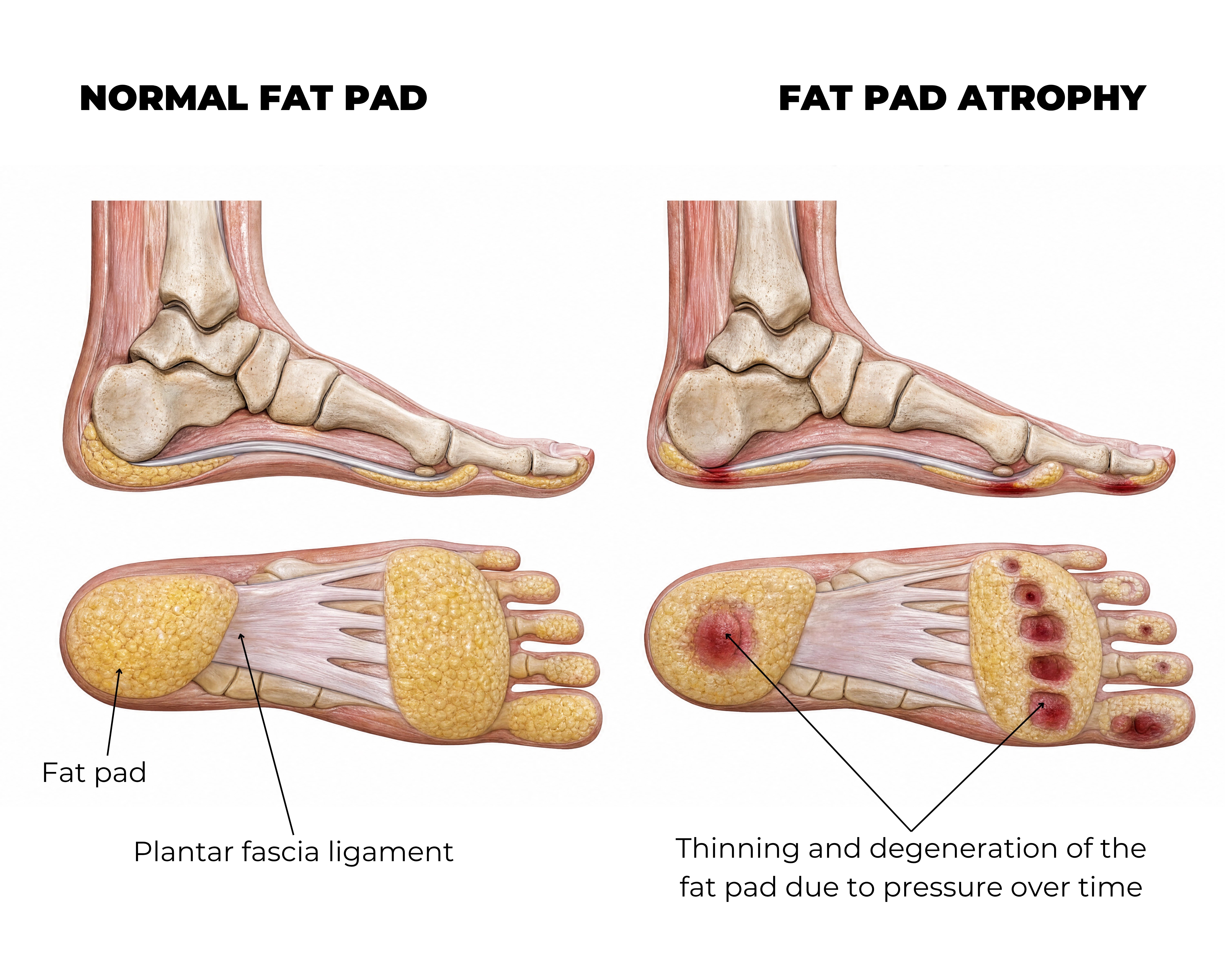
From there, the damage climbs. Your arch starts compensating for support that isn't there anymore, and that's when it tips into Plantar Fasciitis, the sharp, tearing pain a lot of workers feel with their first steps out of bed. Then, without even realizing it, you start shifting your weight when you stand, trying to protect the parts that hurt. So your ankles start absorbing what your feet no longer can. Then your knees pick up what your ankles can't handle. Then your lower back, trying to hold up a whole chain that's been failing from the ground up the entire time.
“By the time someone comes to me about their back,” Torres says, “the real problem usually started in their boots two years earlier. They just never felt it happen.”
And that's the trap. Every stage of this feels like a separate problem with a separate cause. The heel pain feels like heel pain. The knee feels like a knee thing. The back feels like age, or a mattress, or lifting something wrong. Almost nobody draws a line connecting all of it back to a flat piece of foam in a boot they replaced eight months ago. So they treat each piece on its own, chase each new pain as it shows up, and the one thing actually driving the whole cascade never gets touched.
The Part That Should Make You Angry
What makes it worse, Torres says, is that the people who sell the boots already know.
Most major boot manufacturers quietly acknowledge in their own technical documentation that their factory insoles are minimal, built to meet a basic manufacturing standard, not to hold up under sustained wear on hard surfaces. The leather, the safety toe, the outsole, all of it engineered to last for years. The insole inside? Built to a completely different, far lower standard.
“They've known the whole time,” he says. “They just never told you clearly enough. And they definitely never told you what actually works.”
What He Actually Tells His Patients To Do
“This is what I recommend to the people who come to see me,” Torres says. “And honestly, it's what I'd give anything to have been able to tell my grandfather, decades before it was too late to matter.”
The insole he points them to is called WorkFit™, and the reason he trusts it is that it isn't one flat piece of foam waiting to collapse. It's built in four separate zones, each doing a different job.
Torres tested WorkFit™ with 150 workers who were already living with chronic foot pain from hard floors. After ninety days, 127 of them reported significant to complete relief. When the insoles themselves were measured, they'd lost just 4% of their cushioning. A standard foam insole loses forty to fifty percent over the same stretch. He wears the same pair in his own clinic shoes, every working day.
- 127 out of 150 reported significant to complete relief
- 4% cushioning lost at 90 days
- 40–50% lost by standard foam insoles
The Future You're Actually Working For
None of this, Torres is careful to say, is only about the pain you feel right now.
It's about not being the patient sitting across from him in eighteen months, asking whether surgery is the only option left. It's about making sure that after a lifetime of hard work, you actually get to enjoy what you worked for, instead of watching it from a chair because nobody told you the one thing that could have changed it.
WorkFit™ comes with a 30-day guarantee. If it doesn't help, you've lost nothing by trying it. And if it does, you've quietly bought yourself back the years you were starting to worry you might not get.
CLICK HERE To Get SoleBrace® WorkFit™ Insoles
GET YOUR WORKFIT INSOLESWhat Workers Are Saying
